
In 1886, Henri Lebasque settled in Paris and enrolled at the Académie Colarossi, one of the leading private art academies that emerged after the closure of the Académie Suisse in 1870. These independent schools offered a more accessible and less restrictive alternative to the École des Beaux-Arts, where academic conventions still prevailed. To support himself, Lebasque applied his artistic skills to decorative painting and the polychromy of religious sculpture.
Although he belonged to a younger generation than the great Impressionist masters, Lebasque was deeply influenced by their work, particularly their treatment of light and their celebration of the natural world. It was only at the beginning of the twentieth century that he met the ageing Camille Pissarro. By the end of the nineteenth century, he had also become acquainted with the Neo-Impressionists, or Divisionists, Maximilien Luce (1858-1941) and Paul Signac (1863-1935).
While living in Paris, recurring health problems prompted him to move to the countryside, first settling in the Marne region. There he produced numerous landscape paintings depicting river scenes, sunlit villages and woodland settings. In 1903, he exhibited at the inaugural Salon d'Automne, where the French State acquired his large Impressionist canvas Le Goûter sur l'herbe (Picnic on the Grass).
Henri Lebasque, Le Goûter sur l'herbe, 1903. Oil on canvas, H. 124; W. 141 cm. Purchased at the Salon, 1903. © RMN-Grand Palais (Musée d'Orsay) / Martine Beck-Coppola.
Lebasque first discovered the South of France in 1906 and would eventually settle there permanently with his wife and children. During this period, he was associated with the Fauves, particularly Henri Matisse (1869-1954). His palette became brighter and freer, his forms more simplified, and his compositions embraced the vibrant colour harmonies inspired by Mediterranean light.
Henri Lebasque, Sur le banc vert, Sanary, 1911. Oil on canvas, H. 93; W. 130 cm. Private collection.
In 1922, Galerie Eugène Druet devoted a solo exhibition to his work. The following year he stayed in Le Pradet, near Toulon, before settling permanently in Le Cannet, close to Cannes, in 1924.
After moving to Le Cannet, Lebasque became particularly close to Pierre Bonnard (1867-1947), a leading member of the Nabis who also lived nearby. The Mediterranean landscape, its radiant light and mild climate became central to his increasingly intimate vision of painting. Yet unlike the Fauves, Lebasque never abandoned a sense of restraint, preserving throughout his career a remarkable delicacy and lyrical sensitivity.
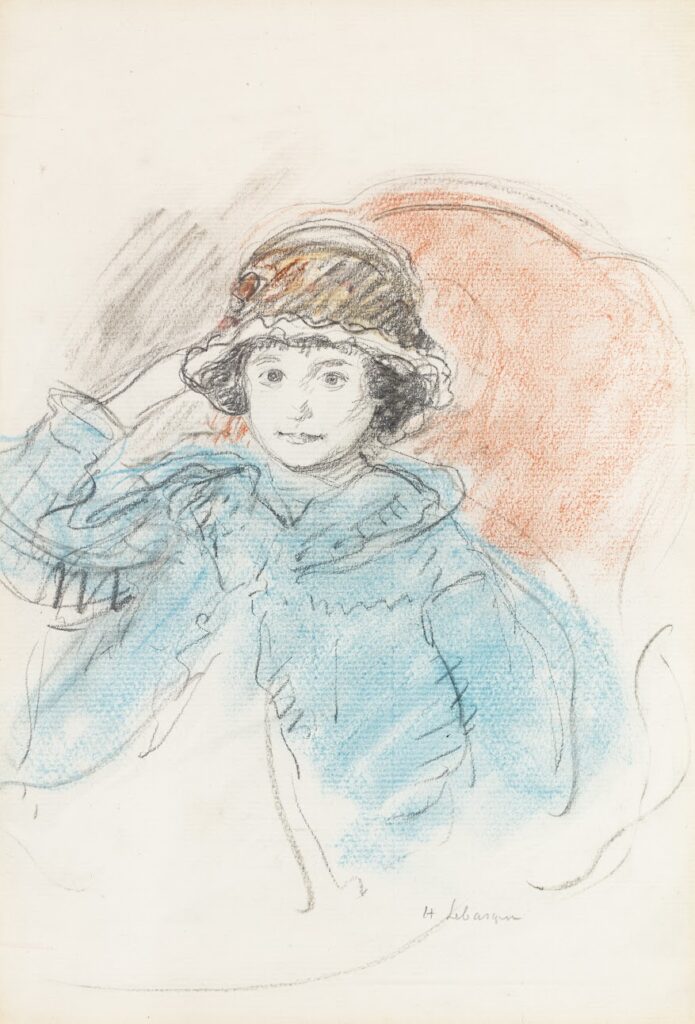
His favourite subjects were domestic scenes set against Mediterranean backdrops. His work frequently explored themes of femininity and childhood, with his wife Catherine ("Ella"), his daughters Marthe and Hélène ("Nono"), and his son Pierre serving as his principal models.
Henri Lebasque, Marthe, circa 1925. Pencil and pastel on paper, H. 24.5; W. 36.5 cm. Galerie Rousset collection.
Henri Lebasque resists easy classification within any single artistic movement. His work reflects the richness of his artistic journey: from the Impressionist handling of light that characterised his early paintings, to the Divisionist techniques inspired by Paul Signac and Maximilien Luce, and later the brighter palette encouraged by his contact with the Fauves. From 1924 onwards, Pierre Bonnard exerted perhaps the most lasting influence on his work. Living in close proximity, the two artists shared a profound interest in intimate domestic life, luminous interiors and the poetry of everyday moments.
Ultimately, Henri Lebasque remained an artist who evolved naturally with the artistic currents of his time while preserving a distinctive voice—one defined by serenity, harmony and an enduring celebration of light, nature and family life.
Discover the works by Henri Lebasque presented at Galerie Rousset, including the pastel Marthe and the drawing Boy with watermelon.