
The Belgian poet Christian Dotremont established the intellectual foundations of the movement, envisioning CoBrA as an open, collaborative and fundamentally non-dogmatic collective.
Its founding manifesto, La Cause était entendue, expressed a rejection of the dominant artistic conventions of the time while advocating a collective, spontaneous and authentic form of artistic creation. For its members, CoBrA represented a radical response to the trauma of war—a return to creativity in its purest and most instinctive form.
As Dotremont wrote:
"An experimental organic collaboration that avoids all sterile and dogmatic theory... We discovered that our ways of living, working and feeling were shared; we understood one another through practice, and we refused to enlist under any artificial doctrine."
The CoBrA artists embraced an intuitive approach inspired by unconventional sources, including so-called "primitive" art, children's drawings, folk art and the creations of psychiatric patients. They celebrated spontaneity, experimentation and the direct expression of emotion, believing that artistic authenticity could only emerge through freedom rather than intellectual constraint.
It is particularly significant that the movement emerged less than a decade after the discovery of the prehistoric cave paintings at Lascaux, whose expressive power profoundly influenced many post-war artists searching for the origins of human creativity.
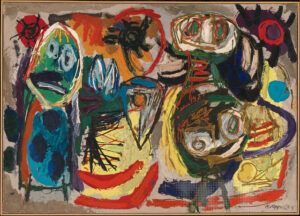
People, Birds and Sun, Karel Appel (1921 2006). People, Birds and Sun, c. 1954. Oil on canvas, 68 1/8 × 95 1/4 in. (173 × 242 cm). Tate Modern Collection, London.
CoBrA rapidly gained international recognition, attracting artists from across Europe and exhibiting extensively in the major capitals of Northern Europe. Although the movement was not born in Paris, it was there that it gained much of its momentum during the 1950s.
In November 1949, Amsterdam hosted the International Exhibition of Experimental Art, one of CoBrA's defining events. Alongside these exhibitions, the group regularly published its journal, CoBrA, as well as numerous collaborative publications that reflected its interdisciplinary spirit.
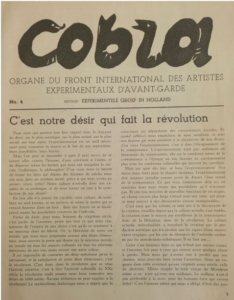
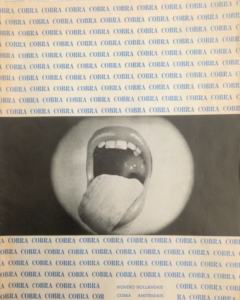
CoBrA No. 4, International Review of Experimental Art. 1949, 9 1/2 × 12 5/8 in. (24 × 32 cm). Private Collection.
CoBrA's remarkable success proved as brief as it was influential. Only three years after its creation, the movement came to an end. The geographical distance separating its members, together with the declining health of Asger Jorn and Christian Dotremont, gradually brought their collective adventure to a close.
In October 1951, the final issue of CoBrA was published, officially marking the dissolution of the movement.
Yet CoBrA's influence continues to resonate throughout the history of modern and contemporary art. Its pursuit of spontaneous expression, liberated from academic conventions and cultural norms, profoundly inspired subsequent generations of artists.
Despite its short existence, CoBrA is now recognised as one of the most important avant-garde movements of the post-war period. Its international outlook, collaborative ethos and revolutionary spirit remain evident in many later artistic practices, from Neo-Expressionism to contemporary street art.
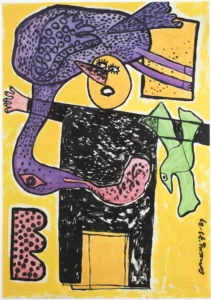
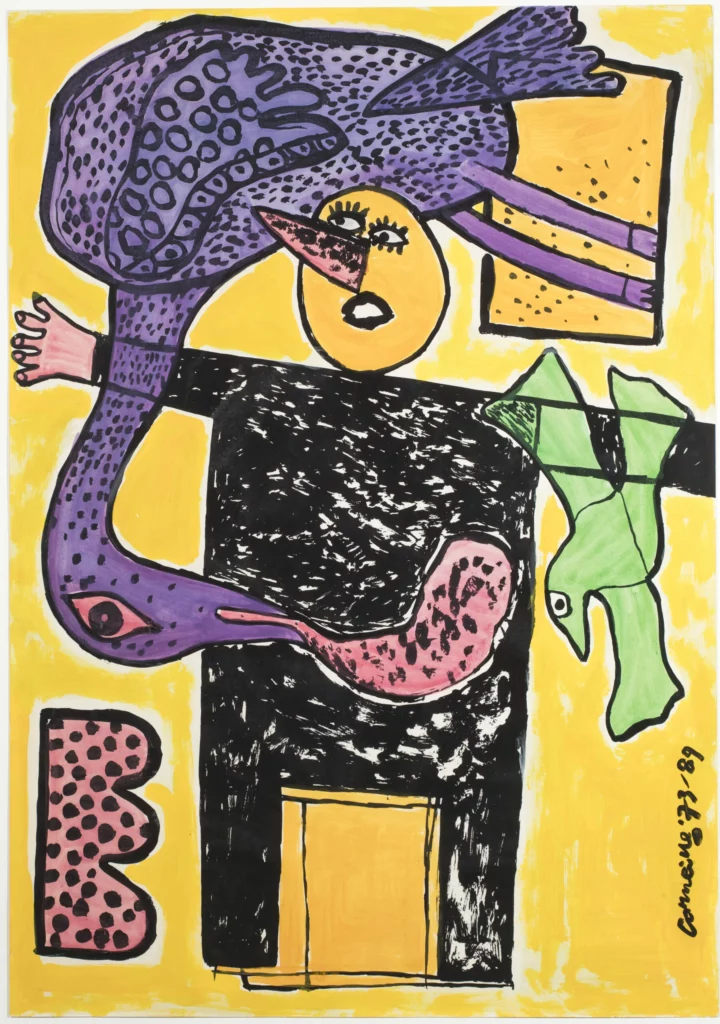
Corneille (1922–2010), Figures and Birds, 1973–1989. Hand-enhanced lithograph with watercolour , 38 5/8 × 27 1/2 in. (98 × 70 cm). Galerie Rousset Collection.
You can find on our website few painters who represent this movement, such as Corneille, Lucebert, Louis Van-Lint, Finn Pedersen ...