

After opening his workshop in Paris at the beginning of the twentieth century, Edgar Brandt first produced works influenced by Art Nouveau. His early creations are distinguished by their curved lines and by decorative motifs inspired by nature, such as flowers and foliage.
From the 1920s onwards, his style gradually evolved towards Art Deco. He favoured more restrained, geometric forms, balanced compositions and great precision of execution. His work combined the traditional know-how of the ironworker with industrial innovations, notably through the use of new welding techniques.
Brandt's creations are at once decorative, elegant and functional. He worked mainly in wrought iron but also combined it with other materials such as bronze, glass and marble. He collaborated with prestigious French manufacturers such as Daum and Lalique.
Edgar Brandt (1880-1960), Console with a thick rectangular top in Portor marble resting on five curved steel blades, polished and engraved with geometric motifs, the base with five inverted polished steel blades on a truncated conical plinth in the same marble, circa 1930. 99 x 126.5 x 45.5 cm.
Nature remained a constant source of inspiration in his work. He depicted plant and animal motifs, simplifying and stylising them to integrate them into a decorative vocabulary that was distinctively Art Deco.
The year 1925 marked an important milestone in his career. At the International Exhibition of Modern Decorative and Industrial Arts in Paris, he presented monumental ironworks that met with great success and helped establish his reputation internationally.
That same year, he founded the Galerie Brandt in Paris. This space did not only showcase his own creations, but also welcomed the works of other decorative artists. The gallery quickly became a major venue for the promotion of Art Deco before expanding to London and New York.
Edgar Brandt (1880-1960), Hammered wrought-iron screen decorated with stylised fish and seaweed, circa 1925. 69 x 65 x 22 cm.
Alongside his artistic activity, Edgar Brandt developed a major industrial enterprise. During the First World War, he designed innovative mortars and munitions. Later, he created the Brandt brand of household appliances, whose name is still known today.
Edgar Brandt died in Switzerland on 8 May 1960, leaving a considerable legacy. His works are now held in numerous museums and private collections, and their artistic quality and technical mastery make him one of the greatest representatives of French Art Deco.
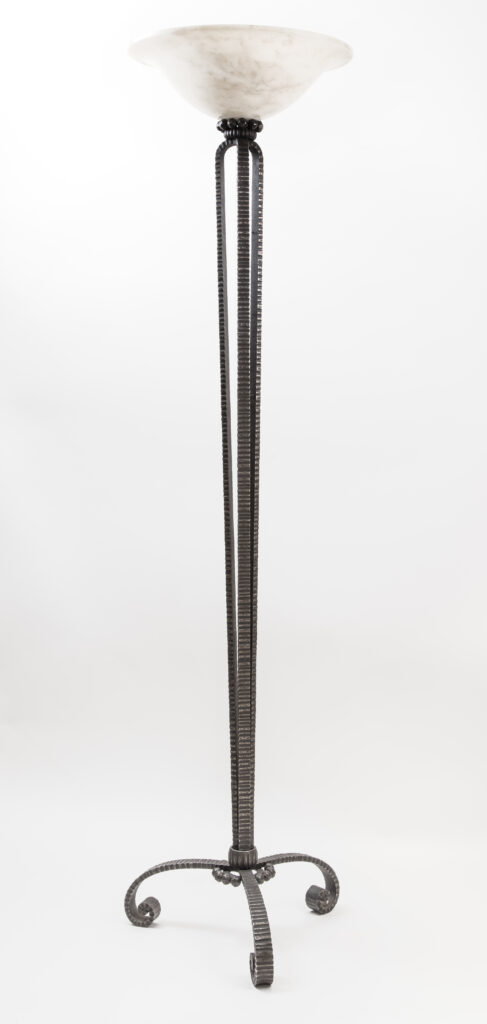
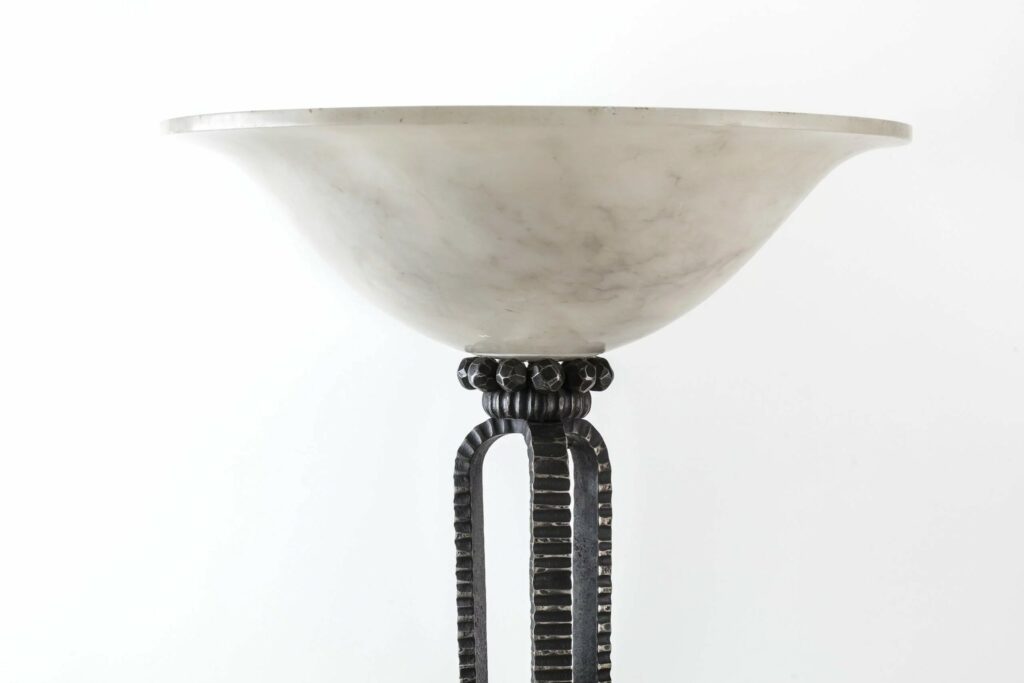
Edgar Brandt, Art Deco lamp, France. Alabaster basin on a wrought-iron base, signed E.BRANDT. 70 x 17.7 cm. Galerie Rousset Collection.
Discover the works by Edgar Brandt presented at Galerie Rousset, including the Art Deco lamp in alabaster and wrought iron reproduced above.