
The story of Pont-Aven began long before Gauguin arrived. During the 1860s, the opening of the railway connecting Paris to Quimper made this previously remote region far more accessible. American painters such as Henry Bacon and Robert Wylie, British artists including Lewis and Carraway, Scandinavian painters such as Amélie Lundahl and Elin Danielson-Gambogi, and later numerous French artists, were drawn to the village by its modest cost of living and the richness of its Breton scenery.
Artists gathered in now-legendary inns such as the Pension Gloanec and the Hôtel Julia, where ideas circulated as freely as brushes and palettes. This atmosphere of creative exchange gradually transformed Pont-Aven into an international artistic community, often regarded as the "new Barbizon."
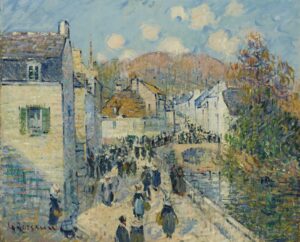
Gustave Loiseau (1865–1935), Market Day in Pont-Aven, c. 1922. Signed G. Loiseau (lower left). Oil on canvas, 23 5/8 × 28 3/4 in. (60 × 73 cm). Private Collection, United States.
Paul Gauguin's arrival in 1886 marked a decisive turning point in the village's artistic history. Two years later, his collaboration with Émile Bernard gave rise to a radically new pictorial language known as Synthetism.
Rejecting the Impressionists' faithful observation of nature, Synthetism sought instead to express its essential character. Artists favoured broad areas of pure colour, bold outlines, simplified forms and compositions that deliberately abandoned traditional perspective. Painting became the expression of memory, emotion and personal interpretation rather than a direct transcription of reality.
This innovative approach profoundly influenced Symbolism, the Nabis and many of the avant-garde movements that shaped early twentieth-century art. Although the Pont-Aven School, in its strictest sense, existed for only a few years—from 1888 to 1894—its artistic influence proved remarkably enduring.
Born in Paris in 1865, Gustave Loiseau discovered painting after first working as an apprentice butcher. Trained under landscape painter Fernand Quignon before studying at the École des Arts Décoratifs, he quickly embraced an Impressionist sensibility while developing an unmistakably personal style.
Following Quignon's advice, Loiseau began visiting Pont-Aven regularly from 1890 onwards, staying at the Pension Gloanec alongside artists such as Henry Moret, Maxime Maufra and Émile Bernard.
Unlike Gauguin, however, Loiseau never fully embraced the principles of Synthetism. He remained deeply committed to direct observation, atmospheric effects and the subtle variations of natural light. His work therefore forms an elegant bridge between Impressionism and Post-Impressionism.
His mature style became immediately recognisable through his characteristic cross-hatched brushwork, often described as a lattice-like network of intersecting strokes. This distinctive technique structures the painted surface while preserving the luminous vibration inherited from Monet and Pissarro, allowing him to render foliage, reflections and changing skies with exceptional delicacy.
Where Gauguin often sought a symbolic—even mythical—vision of Brittany, Loiseau remained fascinated by its everyday reality.
He painted tree-lined roads, rivers, mills, markets and fishing ports with remarkable sensitivity to changing seasons and weather conditions. For more than three decades, Pont-Aven became his artistic laboratory, a place to which he returned time and again.
His paintings not only document the gradual transformation of the village but also preserve the peaceful atmosphere that had first captivated the artists of the Pont-Aven colony.
Today, Gustave Loiseau is recognised as one of the artists who most successfully carried forward the spirit of Pont-Aven after Gauguin. His works feature prominently in the collections and exhibitions of the Musée de Pont-Aven.
Through a more naturalistic approach, Loiseau demonstrated that the legacy of Pont-Aven could never be confined to a single artistic style. The creative freedom born within this small Breton village enabled each artist to develop a unique visual language.
To this day, Pont-Aven remains one of the defining paces in the history of French art. If Gauguin embodies its revolutionary spirit, Gustave Loiseau represents its continuity: an artist who, without abandoning the principles of Impressionism, transformed the light of Brittany and the landscapes of Finistère into the enduring thread running throughout his life's work.
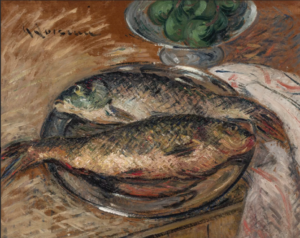
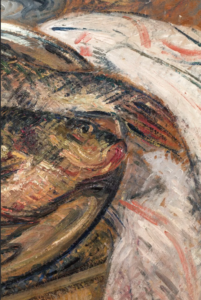
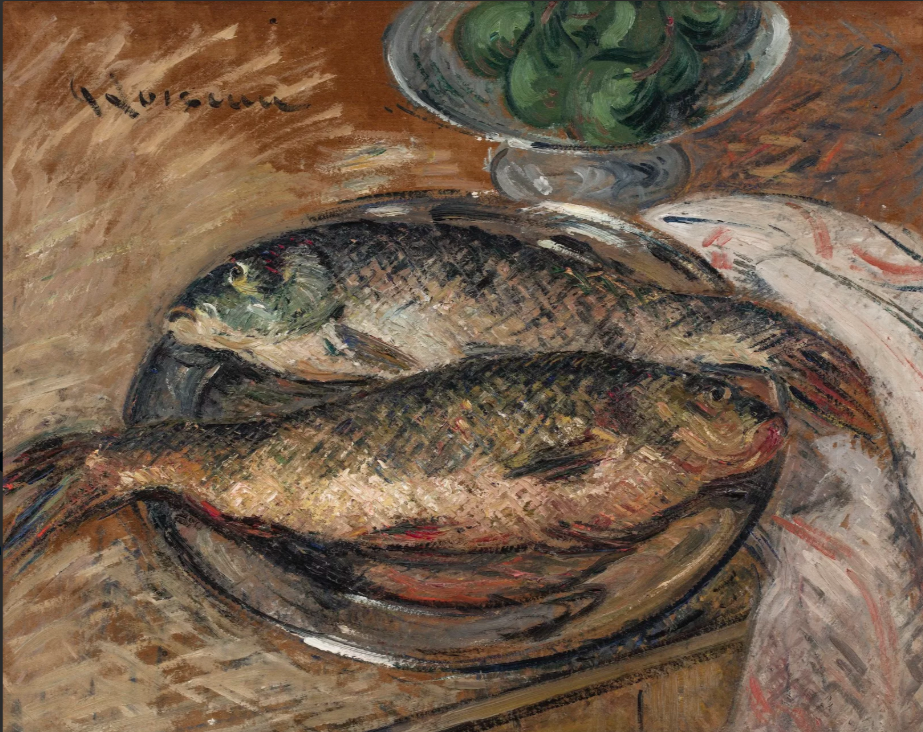
Gustave Loiseau (1865–1935), Still Life with Carp. c.1929. Oil on academy board, 34 1/2 × 29 7/8 in. (87.5 × 76 cm). Galerie Rousset Collection.
To learn more about Gustave Loiseau and discover the works held in Galerie Rousset's collection, please click here.