
When Paul Signac first encountered the paintings of Claude Monet in the early 1880s, he quickly abandoned his architectural studies to devote himself entirely to painting. Like the Impressionists before him, he sought to capture the fleeting effects of light, atmospheric variations and the changing colours of the natural world.
Born in opposition to academic painting, Impressionism favoured scenes of modern life, landscapes and plein-air painting. Rather than pursuing precise representation, artists such as Monet, Renoir, Pissarro and Sisley employed rapid, broken brushstrokes to convey visual sensation and the immediacy of perception. It was within this artistic legacy that Signac first developed his practice before helping to initiate a new artistic revolution.
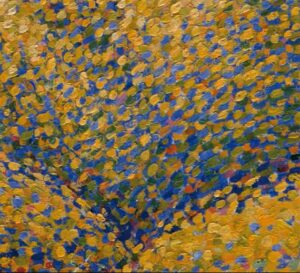
Paul Signac, Detail of Concarneau, Calm Evening, c. 1891. Oil on canvas, 25 1/2 × 32 in. The Metropolitan Museum of Art, New York. The Robert Lehman Collection (1975.1.209)
Signac's meeting with Georges Seurat in 1884 marked a decisive turning point in his career. Together, they established the foundations of Neo-Impressionism, a movement that introduced a more scientific approach to colour theory.
Unlike the Impressionists, who frequently mixed pigments on their palettes, Seurat and Signac applied small touches of pure colour directly onto the canvas, placing complementary colours side by side. Rather than blending physically, the colours combine optically in the viewer's eye when observed from a distance—a phenomenon known as optical mixing.
Although this technique is commonly referred to as Pointillism, it is more accurately described as Divisionism. Pointillism simply refers to the application of small dots or touches of paint, whereas Divisionism is based on the systematic separation of colours to achieve maximum luminosity and chromatic intensity. Signac himself preferred the latter term, considering it a more accurate reflection of his artistic philosophy.
Following Seurat's untimely death in 1891, Paul Signac became the foremost advocate of Neo-Impressionism.
In 1899, he published his landmark treatise, From Eugène Delacroix to Neo-Impressionism, in which he set out the theoretical foundations of the movement and examined colour theory, drawing in particular upon the scientific research of Michel-Eugène Chevreul.
Alongside his own artistic practice, Signac played a crucial role in promoting the avant-garde. A co-founder of the Société des Artistes Indépendants in 1884, he later became its president and actively supported emerging artists such as Henri Matisse and André Derain, thereby contributing indirectly to the birth of Fauvism.
His influence therefore extended well beyond Neo-Impressionism, helping to shape the broader evolution of modern art.
A passionate sailor, Signac owned several boats and travelled extensively along the French coastline and through the ports of Europe. The sea soon became the defining subject of his work.
From the 1890s onwards, he spent long periods in Saint-Tropez, then still a modest fishing village. Its harbours, sailing boats, quays and shimmering reflections offered an ideal setting for his continued exploration of light and colour harmony.
Gradually, the tiny dots that characterised his early paintings gave way to larger, mosaic-like brushstrokes while preserving the essential principles of optical colour mixing.
At the height of his artistic maturity, Signac transformed familiar coastal landscapes into remarkable orchestrations of colour. His juxtaposed brushstrokes do far more than describe the visible world—they generate a luminous vibration that animates the entire composition. Water, sails and sky interact in a chromatic harmony that defines his mature style, where the scientific rigour of his early years evolved into a freer and more expressive language without ever abandoning the principles of Divisionism.
Through these serene maritime scenes, Signac expressed a profoundly optimistic vision of the world, one in which light itself became the true subject of painting.
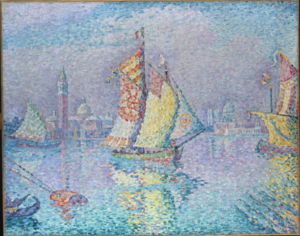
Paul Signac (1863–1935), Venice, the Yellow Sail, c. 1904. Oil on canvas. Musée des Beaux-Arts et d'Archéologie, Besançon. Public Domain.
Today, Paul Signac remains one of the foremost representatives of Neo-Impressionism. His work embodies a rare balance between scientific inquiry and artistic sensitivity, united in a shared ambition to reinvent the representation of reality through colour.
By elevating colour to an autonomous visual language, Signac paved the way for many of the twentieth century's avant-garde movements, from Fauvism to certain forms of abstraction.
Far more than Seurat's disciple, Signac emerged as the movement's great ambassador—the artist who preserved, developed and disseminated one of the most influential pictorial revolutions in the history of modern art.
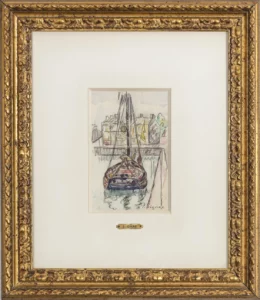
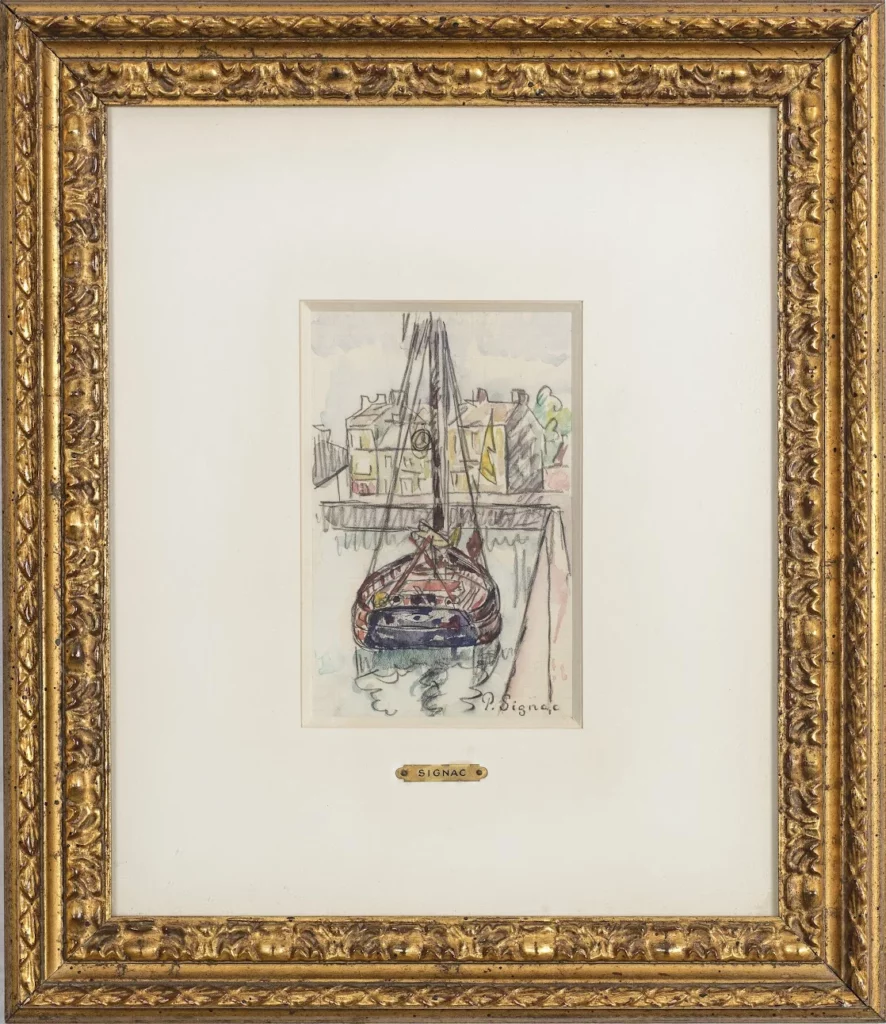
Paul Signac (1863–1935), Sailboat in the Harbour, c. 1925. Watercolour and pencil, 14 3/8 × 16 7/8 in. Galerie Rousset Collection.
To learn more about Paul Signac and discover the works held in Galerie Rousset's permanent collection, please click here.