

A decisive moment in the artistic development of Francisco Zúñiga came with his discovery of modern European artists, including Emil Nolde, Käthe Kollwitz, Constantin Brâncuși, Paul Cézanne and Aristide Maillol. Encountering their work through exhibitions and art journals profoundly broadened his artistic vision.
Although Zúñiga experimented with oil painting, often using his brothers and sister as models, sculpture remained at the heart of his practice. In 1929, he received the Second Prize for Sculpture at the National Exhibition of Fine Arts in Costa Rica, before winning First Prize two years later at the Third National Exhibition of Fine Arts in 1931.
His growing interest in the Mexican Muralist movement led him to Mexico at the age of twenty-three. While working as an assistant in several sculpture studios, he immersed himself in the country's rich pre-Hispanic artistic heritage through the collections of Mexico City's former Museum of Anthropology.
In 1935, he was awarded First Prize at the Costa Rican Salon of Sculpture for his stone sculpture La Maternidad (Maternity).
Francisco Zúñiga, La Maternidad (Maternity), c. 1935. Cartagena stone, 120 × 80 × 92 cm. Collection of the Maternity Hospital of San José, Costa Rica. Illustrated in the Catalogue Raisonné 1923–1993, Vol. I, No. 34, p. 79.
In 1938, Zúñiga joined the faculty of La Esmeralda, the prestigious School of Painting and Sculpture of Mexico's National Institute of Fine Arts. Appointed professor of sculpture, he remained there until his retirement in 1970.
Throughout the 1940s and 1950s, he produced numerous monumental sculptures, collaborating with architects such as Carlos Lazo and Augusto Pérez Palacios while participating in major international exhibitions. During these decades, he established himself as one of Mexico's leading sculptors.
His growing international recognition was confirmed in 1943 when the Metropolitan Museum of Art in New York acquired two of his drawings, acknowledging the significance of his contribution to Latin American art.
Over the course of his career, Zúñiga worked alongside prominent figures including Guillermo Ruiz, Oliverio Martínez, Diego Rivera and Manuel Rodríguez Lozano. He received numerous national awards for sculpture and became one of the defining artists of twentieth-century Mexican art.
In 1959, he joined the Mexican Union of Painters, Sculptors and Printmakers alongside celebrated artists such as Juan O'Gorman, Carlos Orozco Romero and Jesús Guerrero Galván.
Although sculpture remained his principal medium, Zúñiga also devoted considerable attention to printmaking, producing lithographs at the renowned Atelier Mourlot in France. In 1987, he was elected a member of the Academy of Arts of Mexico.
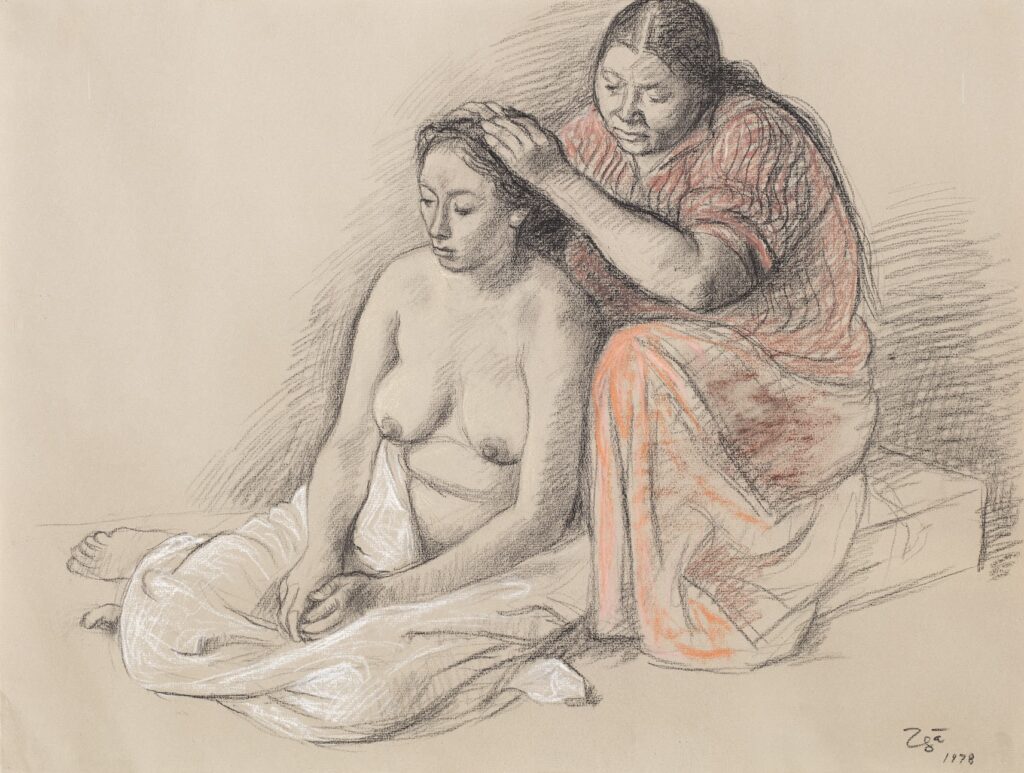
Francisco Zúñiga, El Peinado (Two Women), c. 1978. Coloured pencils on paper, 63.5 × 48 cm. Galerie Rousset Collection.
Whatever the medium, Francisco Zúñiga consistently sought to express fundamental human values. His sculptures are distinguished by their voluptuous, sensuous volumes and monumental proportions, endowing each female figure with both sculptural perfection and a profound metaphysical presence.
Women occupy a central place in his artistic universe. Far from idealised portraits, they embody dignity, serenity and timeless strength. Their generous forms, quiet gestures and contemplative poses reveal Zúñiga's remarkable ability to unite physical presence with inner spirituality.
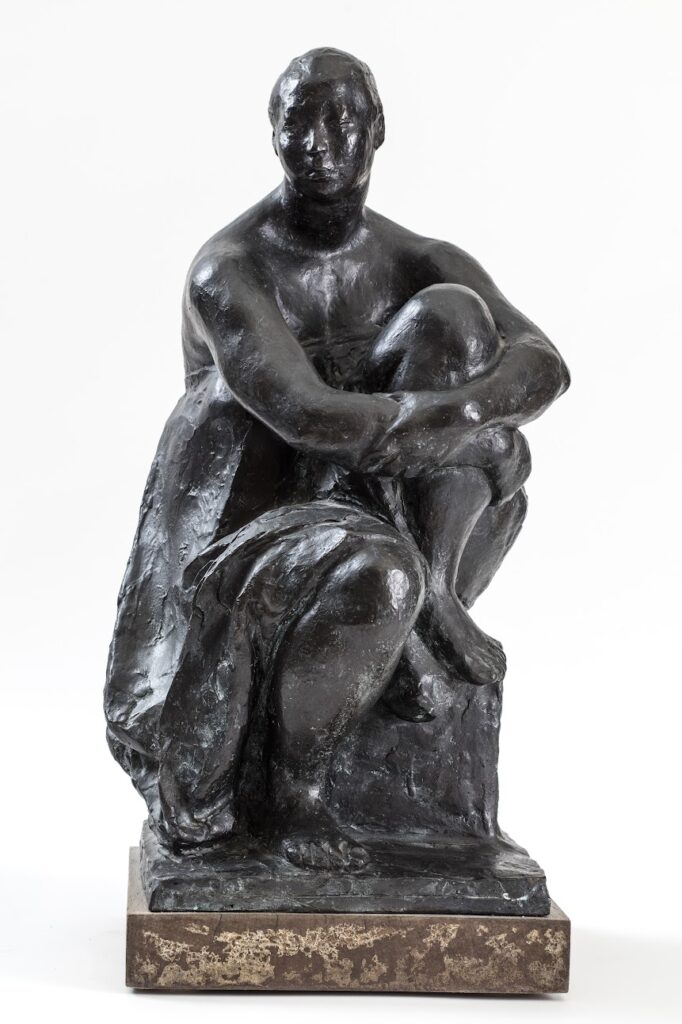
Francisco Zúñiga, Virginia Draped, 1977. Bronze, height: 52 cm. Illustrated in the Catalogue Raisonné 1923–1993, Vol. I, No. 791, p. 460. Galerie Rousset Collection.
Francisco Zúñiga died in Mexico City in 1998, leaving behind one of the most poetic and deeply human sculptural legacies of the twentieth century.
Francisco Zúñiga, Two People in Conversation, 1981. Bronze, 37 × 52 × 25 cm. Collection of the Secretariat of Finance and Public Credit, Mexico. Illustrated in the Catalogue Raisonné 1923–1993, Vol. I, No. 905, p. 522.
Discover the works by Francisco Zúñiga presented at Galerie Rousset, including the drawing El Peinado (Two Women), the bronze Virginia Draped and the drawing Two Women and One Child.