
The history of Vallauris is deeply rooted in its clay-rich soil. Benefiting from exceptional local deposits, the town developed an important ceramic industry as early as Antiquity. For centuries, its workshops specialised in the production of utilitarian pottery, creating jars, pitchers, dishes and everyday household objects.
During the nineteenth century, this long-standing tradition gradually evolved into a more artistic practice. The Massier family played a decisive role in this transformation by developing innovative decorative ceramics distinguished by their research into colour, glazes and form. Their work marked the emergence of a new identity for Vallauris—one in which craftsmanship became a true artistic language.
The artistic destiny of Vallauris changed dramatically after the Second World War with the arrival of Pablo Picasso.
In 1946, while staying on the Côte d'Azur, Picasso discovered Vallauris and met Suzanne and Georges Ramié, founders of the Madoura pottery workshop. Fascinated by the expressive possibilities of clay and the ceramic firing process, he began an extraordinary body of ceramic work that would profoundly transform both his own artistic practice and the international reputation of the town.
Living in Vallauris from 1948 to 1955, Picasso created several thousand ceramic works, including plates, pitchers, vases, sculptures and decorative objects. His highly inventive approach blurred the boundaries between sculpture, painting and traditional pottery, inspiring a new generation of artists to explore ceramics as a fully fledged artistic medium.
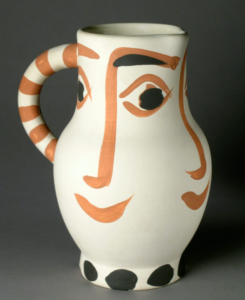
Pablo Picasso (1881–1973), Pitcher with Four Faces circa 1970. Terracotta. Collection of the Los Angeles County Museum of Art, Los Angeles, USA
Picasso's influence quickly extended far beyond his own production. His presence brought international recognition to Vallauris and encouraged numerous artists to settle there. The 1950s consequently became the golden age of Vallauris ceramics.
Throughout the 1950s and 1960s, Vallauris flourished as a remarkable centre of artistic experimentation. Alongside Picasso, artists including Suzanne Ramié, Georges Ramié, Jean Derval, Robert Picault, Gilbert Portanier and Roger Capron played a fundamental role in redefining modern French ceramics.
Rather than viewing ceramics as merely decorative craft, these artists sought to establish it as a major artistic discipline. They experimented freely with forms, textures, glazes and firing techniques, transforming ceramics into a field where sculpture, painting, architecture and design converged.
This creative momentum also reflected the broader social transformations of the Trente Glorieuses, the period of economic prosperity that followed the Second World War. Artists aspired to create objects that were both beautiful and accessible, integrating art into everyday life.
Among the artists associated with Vallauris, Roger Capron occupies a particularly important place.
After studying at the École des Arts Appliqués in Paris, he settled in Vallauris in 1946, founding the Callis workshop with Robert Picault before establishing his own ceramics studio in 1949.
Capron's work perfectly illustrates Vallauris' evolution towards a modern conception of ceramics, where functional objects became works of art in their own right. His production ranged from vases and tableware to monumental architectural panels and his now-iconic ceramic-tiled coffee tables, all reflecting a constant dialogue between craftsmanship, architecture and modern design.
His celebrated series—including Herbier, Navette, Soleil, Sapporo and Garrigue—are now regarded as icons of French design from the 1950s to the 1970s. Through these creations, Capron developed a distinctive visual language inspired by nature, geometric compositions and the expressive qualities of ceramic materials.
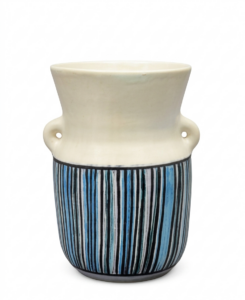
Roger Capron (1922–2006), Anneaux Vase, circa 1959. Glazed earthenware. Illustrated in Roger Capron, Céramiste, Éditions Norma, p. 42.
Today, Vallauris continues to celebrate and preserve its exceptional ceramic heritage. The town remains home to numerous contemporary ceramic artists while safeguarding the legacy of those who transformed it into one of the world's foremost centres of ceramic creation.
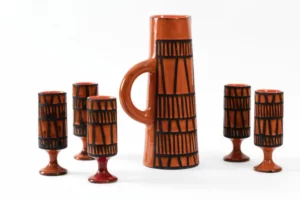
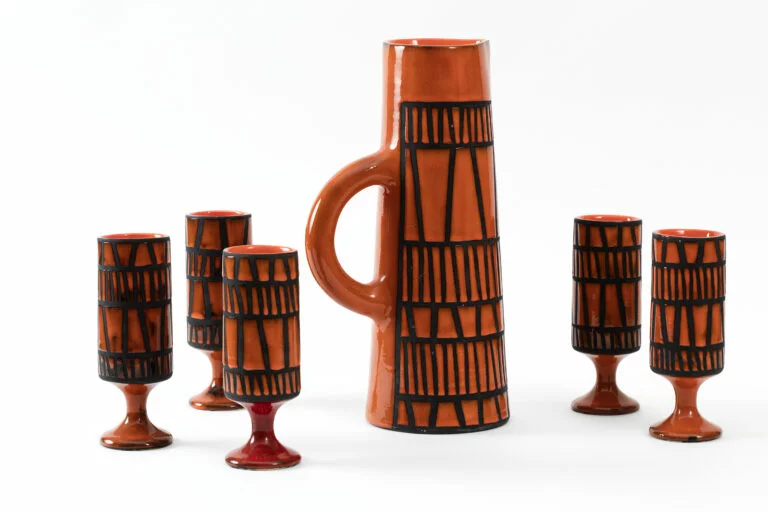
Roger Capron (1922–2006), Orangeade Set. circa 1960. Ceramic. Galerie Rousset Collection.
More than simply a centre of ceramic production, Vallauris represents a pivotal moment in the history of twentieth-century art, when the boundaries between craftsmanship and fine art gradually disappeared. From its local clay to the visionary works of Picasso, Capron and many other artists, the town remains a symbol of a uniquely French approach to ceramics—one founded on experimentation, innovation and modernity.
Discover more about Roger Capron and Galerie Rousset's collection by clicking here.