

It was the French inventor Joseph Nicéphore Niépce who achieved what is now regarded as the world's first permanent photograph. Around 1827, he produced View from the Window at Le Gras by coating a pewter plate with a thin layer of Bitumen of Judea, a naturally light-sensitive substance that hardens when exposed to light. After an exceptionally long exposure—estimated to have lasted anywhere from eight hours to several days—the unhardened bitumen was dissolved away, leaving behind a permanent image.
Joseph Nicéphore Niépce, View from the Window at Le Gras, c. 1827. Heliograph, 16.7 × 20.3 × 0.15 cm.
This process, known as heliography, marked a revolutionary breakthrough. For the first time in history, it became possible to preserve an image created solely by the action of light. Although the process was remarkably slow and technically demanding, it laid the foundations of photography as we know it today.
Following Niépce's death, his collaborator Louis Daguerre continued their research. In 1839, he officially introduced the daguerreotype, widely regarded as the first commercially successful photographic process.
Its principle was relatively straightforward. A copper plate coated with a thin layer of silver was sensitised using iodine vapour before being exposed inside a camera. The latent image was then developed using mercury vapour and permanently fixed through a chemical process.
Unlike later photographic techniques, however, each daguerreotype was a unique object. Since no negative was produced, every portrait or landscape existed as a single, irreplaceable image. Creating additional copies required repeating the entire photographic process from the beginning. Despite this limitation, the daguerreotype enjoyed extraordinary success, particularly for portraiture, which suddenly became far more affordable than painted portraits.
While the daguerreotype was gaining popularity in France, the English scientist William Henry Fox Talbot developed an entirely different approach: the calotype.
Talbot's innovation fundamentally transformed the history of photography. Instead of producing a single finished image, his process created a paper negative from which an unlimited number of positive prints could be made. The invention of the negative became one of photography's greatest milestones, making image reproduction possible for the very first time.
Early photographers using the calotype had to prepare, expose and develop their negatives before the light-sensitive materials dried, often requiring them to carry a portable darkroom into the field. Despite these practical challenges, the process proved more versatile and ultimately more influential than its predecessors, paving the way for modern photographic practice.
The term "silver photography" derives from the Latin argentum, meaning silver.
From Niépce's earliest experiments to modern photographic film, photography has relied on the use of silver salts, primarily silver bromide, silver chloride and silver iodide. These microscopic crystals are dispersed within a layer of gelatin applied to a photographic film or plate.
When exposed to light, these crystals undergo an invisible chemical transformation known as a latent image. This image only becomes visible during the development process, when the exposed crystals are reduced into black metallic silver, while the remaining unexposed areas are removed during fixing. It is this delicate chemical reaction between light and silver compounds that gives birth to silver-based photography.
For much of the nineteenth century, photography remained largely reserved for professionals and highly experienced practitioners. This changed dramatically with the innovations of George Eastman.
In 1884, Eastman developed a flexible roll film, offering a much more practical alternative to heavy glass plates. Four years later, in 1888, he introduced the first Kodak camera, already loaded with enough film to take around one hundred photographs.
Once the roll was finished, users simply returned the entire camera to Kodak. The company developed the negatives, produced the prints, reloaded the camera with a new film, and sent it back to its owner.
The brand's famous slogan perfectly captured this new simplicity: "You press the button, we do the rest."
For the first time, photography became truly accessible to the general public.
During the early twentieth century, cameras became increasingly compact, reliable and efficient. In 1925, the Leica I popularised the 24 × 36 mm format, using 35 mm film originally developed for cinema. This format quickly became the global standard for photographic practice.
Colour photography also experienced major advances. In 1935, Kodak introduced Kodachrome, the first colour film to achieve significant commercial success. Images gained greater realism and chromatic richness, opening new creative possibilities for photographers.
In 1972, Polaroid revolutionised photography once again with the launch of the SX-70, the first fully automatic folding instant camera. Within minutes of taking a photograph, the image gradually appeared before the photographer's eyes, transforming the act of image-making into an immediate and almost magical experience.
From the 1990s onwards, digital cameras gradually became widespread, transforming the way images were created, viewed and shared.
Unlike film photography, digital cameras capture images through an electronic sensor made up of millions of individual photosites. Photographs can be viewed instantly, deleted, edited and shared without waiting for the development process. The cost of each exposure becomes almost negligible, profoundly changing photographic practices and the relationship between photographers and their images.
As digital technology expanded, film sales declined dramatically. Many photographic laboratories closed, and several manufacturers reduced or discontinued their production of photographic film.
Many believed that film photography was destined to disappear. Yet, since the early 2010s, it has experienced a remarkable revival.
This renewed interest can be explained not only by aesthetic considerations but also by a desire to return to a slower and more deliberate approach to image-making. Film photography imposes a form of restraint: each photograph has a cost, the number of exposures is limited, and the final image remains invisible until the development process is complete.
These limitations encourage photographers to consider their composition, lighting and intention more carefully before pressing the shutter.
Beyond this contemplative approach, film photography is also valued for the distinctive qualities of its emulsions: the organic texture of grain, the richness of tonal variations in black and white or colour, and the subtle imperfections that contribute to the unique character of each image. This particular material quality, impossible to fully replicate digitally, gives photographic prints a depth and surface texture that continues to fascinate collectors and enthusiasts around the world.
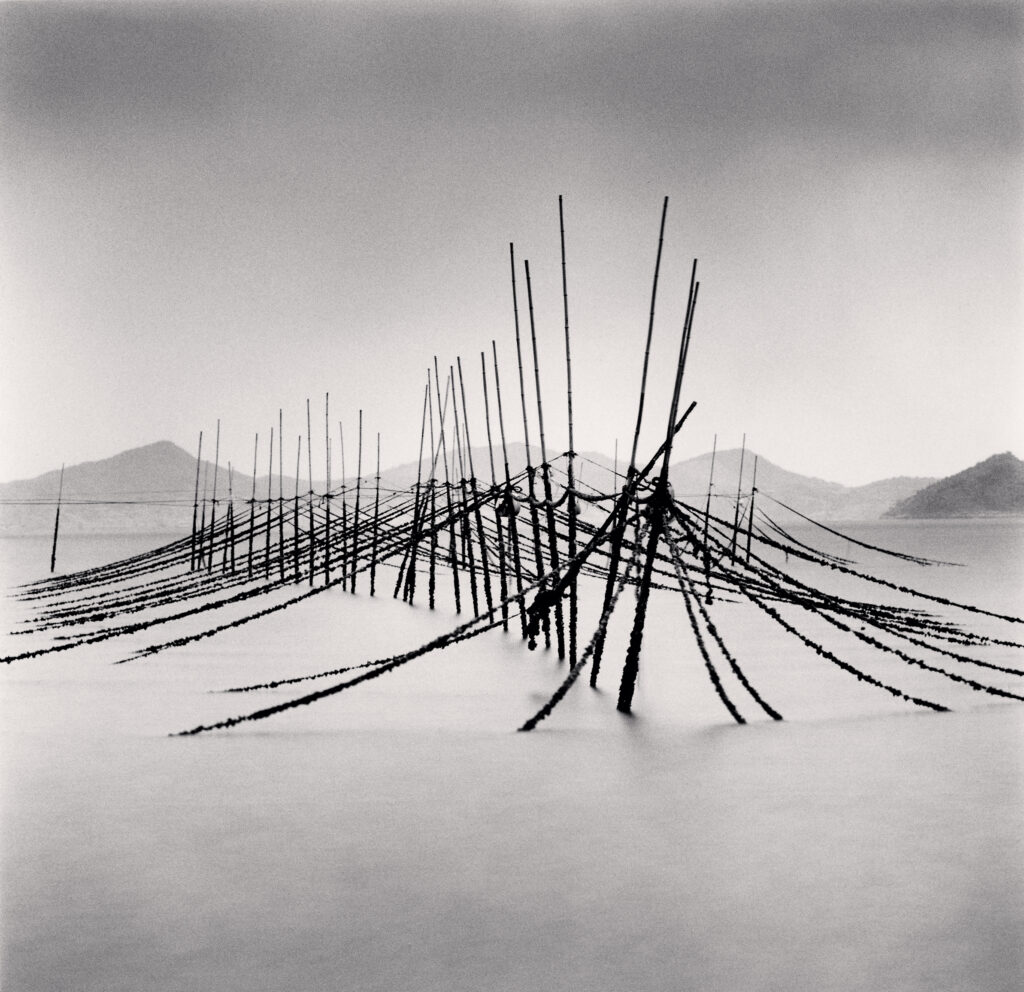
It is within this renewed appreciation for the craft of traditional photography that Galerie Rousset is honoured to present works by the legendary photographer Michael Kenna, whose mastery of black-and-white silver gelatin printing has made him one of the most celebrated contemporary photographers.
Michael Kenna, Aquaculture Structure, Boseong, Jeollanam-do, South Korea, 2018. Silver gelatin print, 19.5 × 20 cm (41 × 51 cm framed). Galerie Rousset Collection.
Discover the prints by Michael Kenna presented at Galerie Rousset, including Aquaculture Structure reproduced above, currently on view as part of the exhibition "Landscapes of South Korea".